
With a good understanding of the cause and structure involved in your shoulder pain, you can then get the right treatment and management plan for your condition.
Shoulder pain can be diagnosed by taking a thorough history of your recent activity and lifestyle, a review of your medical history, and a thorough physical examination.
Imaging can sometimes be useful to rule out any structural damage following injury or serious pathology. It can also be useful if you’re symptoms are not responding to conservative management. Examples of imaging are Ultra-sound, x-ray or MRI.
A Physiotherapist will take a detailed case history to understand the cause and contributing factors to your Shoulder pain.
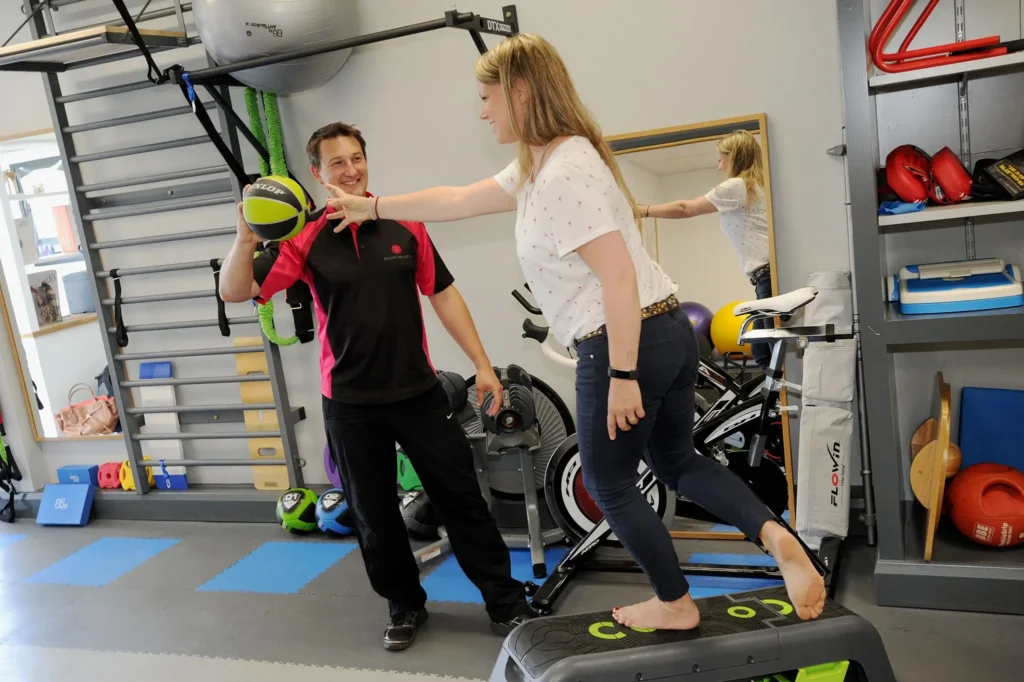
Often the physio will assess your back to ensure it is not involved in your shoulder pain picture. A passive assessment of the shoulder joints combined with a movement screen to identify any biomechanical factors contributing to your symptoms. This may involve a combination of simple shoulder movements or looking at the functional tasks you are struggling with i.e dressing.
The Physiotherapist will then explain what they see and advise on the diagnosis and factors contributing to your pain picture.
Depending on your presentation and expectations of the appointment, the Physiotherapist will advise on any relevant short-term relief options such as optimising pain relief medication, manual therapy techniques i.e. soft tissue release, joint mobilisations or taping. These hands-on techniques provide short term relief and can sometimes help to dampen down the secondary responses to pain such as muscle tightness.
The Physio will also suggest self-management advice i.e. how to modify your activities, simple movement strategies, or an exercise program to address any movement deficits. In some cases, the Physiotherapist may feel onward referral is necessary i.e. back to GP or to a specialist. This will always be a shared decision-making process and often there is lots you can be doing in the meantime.
We use cookies to personalise content and analyse traffic. You can choose which cookies to allow. Privacy Policy • Cookie Policy • Terms & Conditions • Google Privacy
We use cookies to help you navigate efficiently and perform certain functions. You can choose which categories to allow below. Cookies categorised as Necessary are always active.
We also use third-party cookies for analytics and advertising. These are only stored with your consent. You can update or withdraw consent at any time via the cookie icon at the bottom-left. This site operates under UK GDPR, the Data Protection Act 2018, and the Privacy and Electronic Communications Regulations (PECR). Cookie Policy • Privacy Policy
Necessary cookies are required for core site features including security, network management, and consent storage.
| Cookie | Duration | Description |
|---|---|---|
hmdg_cookie_consent | 180 days | Stores your cookie consent preferences. |
PHPSESSID | Session | WordPress session identifier. |
wordpress_logged_in_* | Session | WordPress login authentication. |
Functional cookies enable enhanced features such as live chat and remembering preferences.
| Cookie | Duration | Description |
|---|---|---|
wp-settings-* | 1 year | Stores user interface preferences. |
Analytics cookies help us understand visitor behaviour. Controls analytics_storage for Google Analytics 4.
| Cookie | Duration | Description |
|---|---|---|
_ga | 2 years | Google Analytics — distinguishes users. |
_ga_* | 2 years | Google Analytics 4 — session persistence. |
_gid | 24 hours | Google Analytics — distinguishes users. |
_gat | 1 minute | Google Analytics — throttles request rate. |
Performance cookies collect aggregate, anonymous data about site performance.
| Cookie | Duration | Description |
|---|---|---|
_gat_gtag_* | 1 minute | Google Tag Manager — rate throttle. |
Marketing cookies track visits to deliver relevant ads. Controls ad_storage, ad_user_data, and ad_personalization.
| Cookie | Duration | Description |
|---|---|---|
_gcl_au | 90 days | Google Ads — conversion tracking. |
_gcl_aw | 90 days | Google Ads — click attribution. |
_gac_* | 90 days | Google Ads — campaign information. |
IDE | 1 year | Google DoubleClick — ad targeting. |
Powered by HMDG • Cookie Policy